Waiting Game Winner: The Unexpected Mindfulness Hiding in Britain's Market Queues
Britain queues. It's what we do. While other nations treat waiting as an affront to personal dignity, we form orderly lines outside bakeries in the rain and consider it a perfectly reasonable way to spend a Saturday morning. We've been quietly mocked for this by every other country on earth for decades.
Except — plot twist — we might have been onto something genuinely healthy all along.
A growing body of research into mindfulness, stress reduction, and what psychologists are calling 'slow commerce' is pointing toward an unexpected conclusion: the humble British queue, with all its patience and predictable social ritual, may be functioning as an accidental brain reset. One that no app, no subscription, and no wellness influencer can fully replicate.
The Problem With Frictionless Everything
Before we get to why queuing is secretly brilliant, it helps to understand why its absence is quietly damaging.
The last decade has been defined, technologically speaking, by the elimination of waiting. Same-day delivery. Instant streaming. One-click everything. The friction has been engineered out of commerce so comprehensively that we've largely forgotten what it felt like to simply... pause.
This has consequences. Dr Priya Mehta, a behavioural psychologist at the University of Nottingham, has been researching what she terms 'optimisation fatigue' — the psychological toll of living in an environment where everything happens instantly and any delay feels like a malfunction.
"When we remove all friction from daily life, we inadvertently remove something else too — the natural pauses that allow our nervous systems to regulate," she explains. "We've replaced waiting with scrolling, which feels productive but is actually an additional cognitive load. The queue, by contrast, is a moment where you are genuinely permitted to do nothing. And doing nothing, properly, is incredibly restorative."
Why the Market Queue Is Different From the Supermarket Queue
Not all queues are created equal, and this distinction matters.
The supermarket queue — fluorescent-lit, basket-heavy, hemmed in by chocolate bars you're trying not to think about — is not the experience we're talking about. That queue carries its own low-grade stress. You're tracking the speed of other tills. You're wondering if you picked the wrong lane. Your phone is already in your hand.
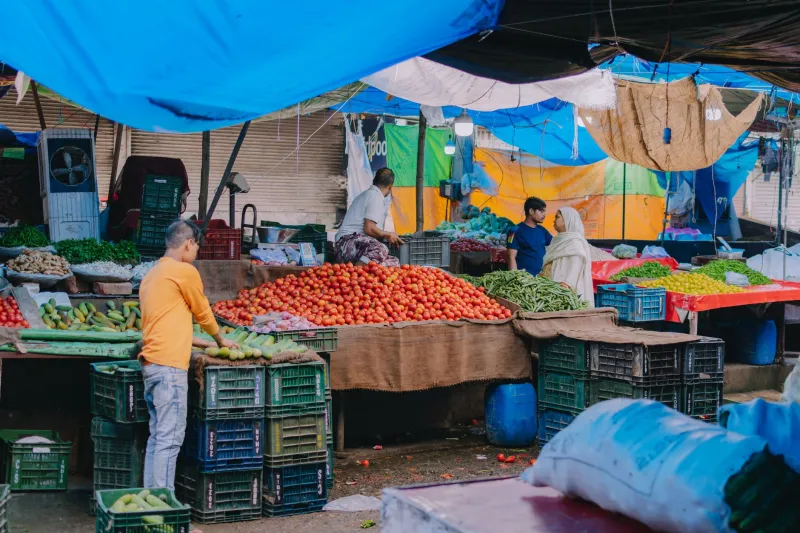
The market queue is an entirely different animal. It moves at the pace of conversation. The person in front of you is asking the fishmonger about the mackerel. The person behind you is telling their child the names of the vegetables. There's no digital display counting down your wait. There's no self-checkout beeping reproachfully at you for placing your bag in the wrong area.
There is just the queue, and the cold air, and the smell of fresh bread from two stalls over, and the entirely reasonable expectation that your turn will come.
"That predictability is key," says Dr Mehta. "The brain finds comfort in social rhythms it can anticipate. A market queue has a clear structure — you arrive, you wait, your turn comes, you interact with a human being, you leave with something tangible. That narrative arc is genuinely satisfying to the brain in a way that frictionless transactions simply are not."
The Unplugged Pause Nobody Planned For
Here's the part that really gets researchers excited: most people in a traditional market or post office queue do not, it turns out, immediately reach for their phones.
Anecdotally, this seems unlikely — we're all addicted, aren't we? But observational studies of non-supermarket retail queuing environments have found that people are significantly more likely to engage in what researchers call 'ambient attention' — looking around, noticing their surroundings, making eye contact, listening — when the queue has a social dimension to it.
In short, when there's a human being serving you at the end of the line, the wait itself becomes part of the social experience. You observe. You overhear. You notice the handwritten sign advertising next week's seasonal veg box. You think, briefly and pleasantly, about nothing in particular.
This is, by any clinical definition, a mindfulness moment. It just doesn't have a logo or a monthly fee.
"We've spent years trying to teach people to be present," says mindfulness practitioner and NHS-affiliated trainer Jonah Cartwright, based in Bristol. "And here's an entire cultural tradition that does it naturally, embedded in an ordinary Saturday errand. The queue is doing the work without anyone having to try."
Slow Commerce as Radical Act
There is a broader movement gathering pace here, and it goes by various names — slow living, intentional consumption, degrowth — but its central argument is consistent: we have optimised our lives to the point of impoverishment, and the antidote is deliberate, unhurried engagement with the physical world.
Farmers' markets, independent butchers, fishmongers, post offices — these are the last bastions of what might be called 'slow commerce.' Transactions that take time. Transactions that involve conversation. Transactions where the product in your hands was handled by someone who knows its provenance.
The mental health benefits of this kind of engagement aren't incidental. They're structural. You can't rush the queue at the cheese stall. You're not meant to. And in surrendering to that pace, you step briefly out of the hyper-optimised churn that defines the rest of modern life.
Queue Up, Stress Down
The practical upshot of all this is refreshingly simple: go to your local market. Take the longer route. Don't pre-order online when you can pop to the butcher's on Saturday morning. Let yourself wait.
Leave your phone in your pocket. Look at the produce. Listen to the conversations around you. Notice that the world, in this particular small corner, is moving at a pace your nervous system actually quite likes.
Britain has been perfecting this ritual for centuries. The scientists have finally caught up. The queue, it turns out, was never just a queue.
It was a prescription.