Mud, Glorious Mud: Why Britain's Pottery Boom Is the Nervous System Reset We've All Been Craving
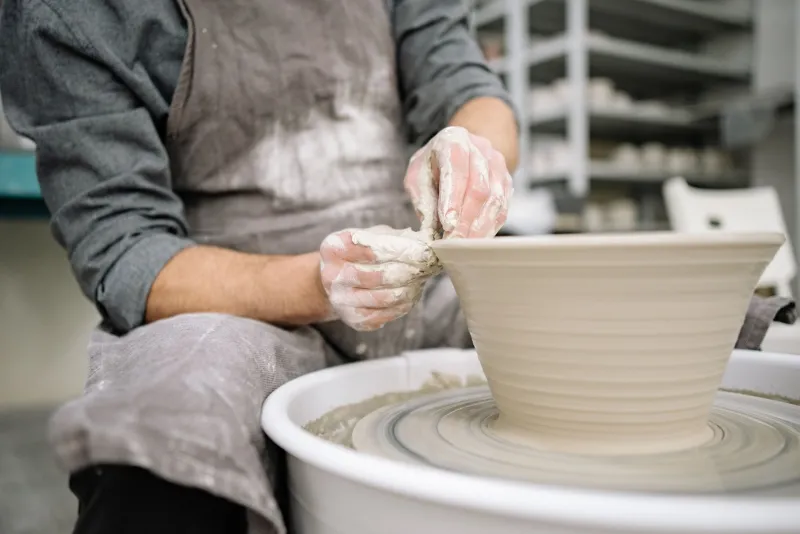
Somewhere in a converted railway arch in Sheffield, a woman named Diane is elbow-deep in a lump of grey stoneware clay, absolutely furious at it, and — paradoxically — experiencing the most peaceful forty minutes of her week.
"It doesn't care about my emails," she says, not looking up. "It doesn't care about anything. It just does what it does. And I have to pay attention to it, or it collapses. That's the whole thing, isn't it? You can't be anywhere else."
Diane is 47, works in HR, and has been coming to her local pottery class every Thursday for eight months. She used to see a therapist fortnightly. She still does — but she'll tell you, without hesitation, that the clay is doing something the therapy sessions can't quite reach. Something physical. Something older.
She's not alone. Across Britain, pottery studios are reporting full rosters, swelling waiting lists, and a demographic that would surprise the art-school stereotype: professionals in their 30s and 40s, burnout survivors, people with anxiety, people who've never made anything with their hands in their adult lives and are, apparently, desperate to start.
The Body Knows Things the Brain Forgets
To understand why pottery works as a wellness intervention, you need to understand a concept that neuroscientists call 'embodied cognition' — the idea that the mind and body are not separate processing systems but deeply intertwined ones. What your hands do affects how your brain feels. What your nervous system experiences through touch influences your emotional state in ways that are direct, immediate, and profound.
Dr Aisha Okafor, a neuroscientist at King's College London who researches sensorimotor processing and emotional regulation, has been paying close attention to the pottery boom.
"The repetitive, rhythmic nature of working with clay engages what we call the 'default mode network' in a very particular way," she explains. "It's similar to what happens during meditation or certain forms of movement therapy — the brain enters a state of focused calm. You're not ruminating. You're not planning. You're responding, in real time, to something tactile and immediate. For people who struggle to access that state through conventional mindfulness, it can be genuinely transformative."
The clay, in other words, does the mindfulness for you. You don't have to try to be present. The present is right there in your hands, and it will absolutely collapse into a wonky mess if you drift off.
From Wheel to Wellbeing: What's Actually Happening in the Studio
Pottery's therapeutic properties aren't new knowledge — occupational therapists have used ceramics in clinical settings for decades. What's changed is the mainstream uptake, the cultural moment that has taken this from hospital art room to high-street studio.
Rob Chandler runs The Clay Room, a pottery studio in Bristol that opened four years ago with six wheels and a prayer. Today he has a 200-person waiting list and has just taken on a third space.
"We didn't set out to be a wellness offering," he says. "We just wanted to teach people to make pots. But within about six months, we started realising what was actually happening in the room. People were coming in stressed and leaving calm. People were crying — happy crying, usually. People were telling us things like, 'I haven't thought about work for two hours. I don't know when that last happened.'"
He now actively collaborates with local GPs and a community mental health team, who refer patients to the studio as part of social prescribing programmes. "We've had people come in who haven't left their house in weeks," he says quietly. "And they made a bowl. A real, tangible thing. You can't overstate what that does for someone."
Why This Works for the Fidgety Generation
Conventional mindfulness — sitting still, focusing on breath, clearing the mind — is brilliant in theory and maddening in practice for a significant portion of the population. If you have ADHD, high-functioning anxiety, or simply a brain that has been trained by years of digital multitasking to find stillness intolerable, being told to 'just breathe' can feel less like a solution and more like a taunt.
Pottery sidesteps this entirely. It gives the fidgety brain something legitimate to do.
"We call it 'active grounding,'" says Dr Okafor. "The hands are occupied. The eyes are focused. The body is engaged. But because the activity is rhythmic and relatively simple once you have the basics, the cognitive load is low enough that the rumination can't get a foothold. It's a back door into the regulated state that anxious people spend enormous energy trying to reach through the front door."
This may also explain why ceramics has found such a devoted following among people who've tried and abandoned meditation apps, yoga classes, and various other wellness prescriptions. The clay doesn't require you to be a certain kind of person. It just requires your hands.
The Community Kiln
There's another dimension to the pottery boom that deserves attention, and it's one that pure neuroscience doesn't fully capture: the social one.
Pottery studios are, almost by nature, communal spaces. You sit around wheels together. You wait for the kiln together. You compare your lopsided mugs and laugh about them together. In a cultural moment defined by isolation and screen-mediated connection, this low-pressure, side-by-side sociality is its own form of medicine.
"People make friends here in a way they don't seem to elsewhere anymore," says Rob Chandler. "You're not performing. You're not networking. You're just making something, and the person next to you is making something, and there's a companionship in that which feels very old and very human."
The research backs this up. Studies into social prescribing and community arts programmes consistently show that group creative activity reduces loneliness scores and improves self-reported wellbeing — often more effectively than individual therapeutic interventions.
Getting Your Hands In
If you're now wondering whether a pottery class might be the thing your nervous system has been quietly asking for, the good news is that the UK scene has never been more accessible. Community studios, adult education colleges, and independent workshops have sprung up in most towns and cities. Many offer taster sessions for under £30. Some, particularly those linked to social prescribing schemes, are subsidised or free.
You don't need talent. You don't need experience. You will almost certainly make something that looks nothing like what you intended.
And that, it turns out, is entirely the point.