Climb Every Floor: Why the Office Stairwell Is the Fitness Upgrade Britain Has Been Ignoring
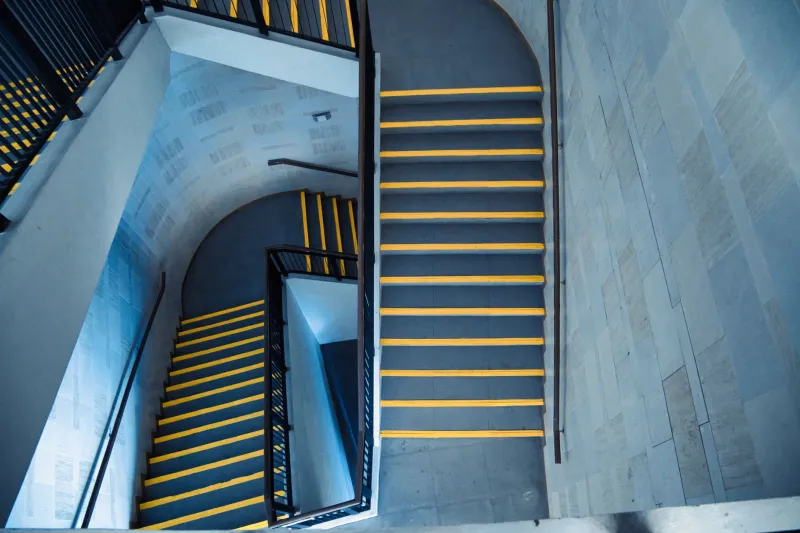
Somewhere in every British office building — tucked behind a fire door, lit by a single flickering fluorescent tube, occasionally hosting a forgotten bicycle — is a stairwell. It exists primarily to satisfy building regulations and to give people somewhere to stand awkwardly during fire drills. It is not, by any stretch of the imagination, considered a fitness facility.
And yet, according to a growing body of research, it arguably should be.
While the wellness industry sells us standing desks, under-desk treadmills, and lunchtime yoga subscriptions, the humble office staircase has been quietly delivering measurable cardiovascular and mental health benefits to the small minority of workers actually using it. The science is increasingly difficult to ignore — and the price of entry is exactly zero pounds.
The Numbers That Should Make You Put Down Your Oyster Card
Let's start with the headline findings, because they're genuinely striking. A study published in the British Journal of Sports Medicine found that stair climbing — even in short, repeated bursts throughout the day — produced significant improvements in cardiorespiratory fitness over a 12-week period. We're not talking about sustained stair-climbing sessions. We're talking about replacing lift journeys with stair journeys, multiple times a day, as a matter of habit.
Separately, researchers at McMaster University in Canada found that three 20-second bouts of vigorous stair climbing, performed three times a day over six weeks, improved cardiovascular fitness by approximately 5% — comparable to results from more structured exercise programmes. Five percent might not sound dramatic, but in terms of long-term health outcomes, it's the kind of number that gets cardiologists interested.
For context, the NHS currently recommends that adults accumulate 150 minutes of moderate-intensity activity per week. Most British office workers fall well short of this. Stair climbing, repeated throughout the working day, can quietly chip away at that deficit without requiring a single trip to a gym, a change of clothes, or even a particularly strong sense of motivation.
What's Actually Happening to Your Body on the Stairs
Stair climbing is classified as a vigorous-intensity exercise, which means it burns roughly twice as many calories per minute as walking on flat ground. It engages the glutes, quadriceps, hamstrings, and calves simultaneously, making it genuinely effective for lower-body strength — not that most people climbing to the fourth floor are thinking about their glutes.
More importantly for the desk-bound masses, brief vigorous activity has been shown to trigger the release of brain-derived neurotrophic factor (BDNF), sometimes called "Miracle-Gro for the brain." BDNF supports the growth and maintenance of neurons, improves memory consolidation, and has been linked to reduced symptoms of anxiety and depression. A two-minute stair climb is, in neurological terms, a meaningful event.
There's also the metabolic angle. Prolonged sitting suppresses the activity of lipoprotein lipase, an enzyme critical for processing fats in the bloodstream. Breaking up sedentary periods — even briefly — restores this enzyme's activity. Regular stair use throughout the day is one of the most practical ways to achieve this without disrupting the working day.
The Built-In Advantage Nobody's Talking About
Here's what makes stairwells uniquely interesting as a public health tool: they already exist everywhere. Every office building in Britain has them. Every hospital, every shopping centre, every block of flats. There's no infrastructure to build, no equipment to buy, no programme to design.
This is actually significant from a public health perspective. One of the consistent findings in exercise science is that proximity and convenience are among the strongest predictors of whether people will actually do something. The gym down the road is used far less than the gym in your building. The fruit bowl on the kitchen counter gets emptied before the fruit in the fridge. Behaviour follows the path of least resistance.
Stairwells are, almost by definition, on the path of least resistance for office workers. The lift and the stairs are typically within metres of each other. The only genuine barrier is habit — and habits, as any behavioural scientist will tell you, are eminently changeable.
Making the Stairwell Work for You (Without Making It Weird)
The most effective approach, according to researchers, isn't to attempt a single heroic stair-climbing session at lunchtime. It's to accumulate stair use in small increments throughout the day — every lift journey replaced, every floor climbed rather than ridden.
For workers in multi-storey offices, this could mean getting out of the lift two floors early and climbing the remainder. For those in lower buildings, it might mean going up and down once before a meeting as a deliberate reset. For anyone working in a building with a canteen or coffee point on a different floor, the routing decision becomes automatic.
Some forward-thinking UK employers are already nudging this behaviour. Motivational signage near lifts — not preachy, just informative — has been shown in studies to increase stair use by up to 50% in workplace settings. A handful of British companies have started recognising stair use in their wellness programmes, though this remains a niche practice.
The NHS's own physical activity guidance increasingly emphasises the value of "incidental" activity — movement that occurs as a natural byproduct of daily life rather than structured exercise. Stair climbing is perhaps the purest expression of this principle.
The Mental Health Bonus Nobody Mentions
Beyond the cardiovascular benefits, there's a quieter argument for regular stair use: it provides micro-breaks from screen time. The average British office worker now spends upwards of seven hours a day looking at screens. Brief physical interruptions — even two minutes of stair climbing — force a genuine cognitive reset that simply standing up at your desk doesn't quite replicate.
There's also something to be said for the slight breathlessness of stair climbing as a mindfulness tool. It's difficult to ruminate about an awkward email exchange when you're slightly out of breath and concentrating on not tripping up a flight of stairs. The body demands your attention, and attention, it turns out, is exactly what an overstimulated brain sometimes needs.
The stairwell won't get a rebrand. It won't appear in wellness influencer content. It will remain slightly echoey and faintly institutional. But the evidence is building — quietly, floor by floor — that it might be the most underrated health asset in the British workplace.
Take the stairs. Tell your colleagues. Watch what happens.