The Loneliness Fix Was Outside All Along: Why 'Green Socialising' Is Transforming British Communities
The Loneliness Fix Was Outside All Along: Why 'Green Socialising' Is Transforming British Communities
Britain has a loneliness problem. That much is well-documented. The Jo Cox Commission on Loneliness famously described it as one of the greatest public health challenges of our time — a conclusion that felt prophetic even before a global pandemic arrived to turbocharge social isolation across the country. Today, the Campaign to End Loneliness estimates that over nine million people in the UK frequently feel lonely. That's not a niche issue. That's a national crisis.
But here's the thing about crises: sometimes the solutions are closer than you'd think. And increasingly, researchers, GPs, and community organisers are pointing to the same answer — one that's been sitting right outside our front doors, waiting patiently in parks, forests, rivers, and rolling countryside all along.
Welcome to the world of green socialising.
What Is Green Socialising — And Why Is It Different?
Green socialising isn't a branded wellness product or a corporate wellbeing initiative. It's an umbrella term for something beautifully simple: groups of people coming together outdoors, in nature, to share an activity and — crucially — each other's company.
Think parkrun. Think wild swimming clubs. Think forest bathing groups, community walking programmes, outdoor yoga in the park, or the hundreds of rambling societies threading their way through the Cairngorms, the Brecon Beacons, and the Pennines every weekend. These activities are hardly new. But what is new is the mounting scientific evidence that combining social connection with time in natural environments produces a wellbeing effect far greater than either element alone.
Dr Miles Richardson, professor of human factors and nature connectedness at the University of Derby, has spent years studying this intersection. "Nature connectedness and social connectedness are both independently powerful predictors of mental health," he explains. "When you combine them — when people are connecting with each other through shared nature experiences — the effects appear to be synergistic. You get more than the sum of the parts."
The Parkrun Phenomenon: A Case Study in Community Wellness
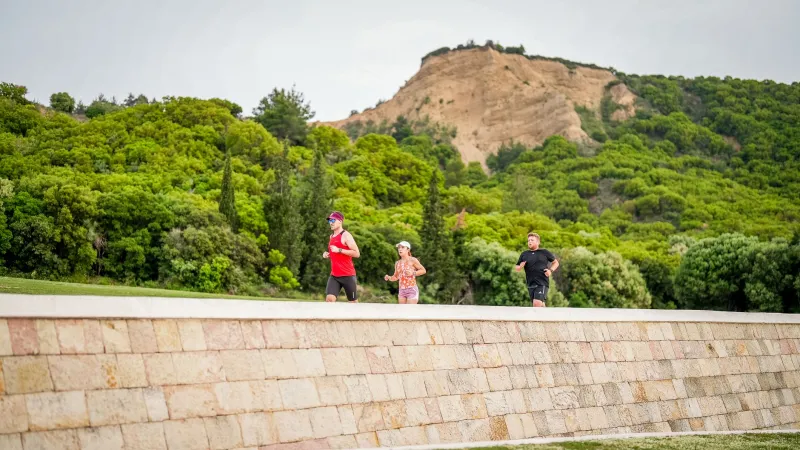
If you want a ready-made example of green socialising at scale, look no further than parkrun. What started as a 13-person timed run in Bushy Park, Teddington, in 2004 has grown into one of the most remarkable grassroots health movements in British history. Today, over 1,000 parkrun events take place every Saturday morning across the UK, with more than 400,000 people participating weekly.
But the real story of parkrun isn't the running. It's the community. Research published in the British Journal of Sports Medicine found that parkrun participants consistently cited social connection — not fitness — as their primary reason for attending. Many participants described their local parkrun as their main social outlet, particularly older adults and those living alone.
Jamie, 54, from Bristol, started attending his local parkrun after his divorce left him rattling around an empty house on weekends. "I'm not a runner, really," he admits cheerfully. "I walk most of it. But I've made proper friends there. People I'd call in an emergency. That's not nothing — that's everything, actually."
His GP, who referred him to parkrun as part of a social prescribing programme, reports that Jamie's anxiety scores have dropped measurably in the two years since he started attending. "It's one of the most effective things I've ever prescribed," she says.
Wild Swimming and the Thrill of Shared Cold Water
If parkrun is green socialising's friendly, accessible face, wild swimming is its more exhilarating cousin. Cold-water swimming has surged in popularity across the UK over the past five years, with estimates suggesting participation has more than doubled since 2019. And crucially, most people aren't doing it alone.
Swimming clubs have sprung up across the country — from the Hampstead Heath ponds in north London to the sea lochs of the Scottish Highlands, from the Wye Valley to the Yorkshire Dales. These groups typically meet at dawn or dusk, plunge into whatever natural body of water is to hand, and then stand around in various states of shivering exhilaration, chatting.
The health benefits of the swimming itself are well-established (see our earlier coverage on cold-water immersion). But the social ritual surrounding it — the shared vulnerability, the communal euphoria of the post-swim high, the regularity of meeting the same faces in the same wild places — appears to be doing something profound for participants' mental health.
A 2023 study from the University of Portsmouth found that group wild swimmers reported significantly lower levels of loneliness and higher levels of social trust than non-swimmers — even when controlling for general physical activity levels. It's not just the cold water. It's the people in it with you.
Sophie, 38, a nurse from Inverness, joined a local wild swimming group after struggling with burnout following the pandemic. "The NHS gave me a lot," she says, laughing slightly, "and took quite a lot too. I was completely depleted. The swimming group gave me something I couldn't have prescribed for myself — people who genuinely looked out for me, in this extraordinary landscape. I feel like myself again."
Forest Bathing: Ancient Practice, Modern Evidence
Forest bathing — or shinrin-yoku, as it originated in Japan — involves slow, mindful immersion in woodland environments. It sounds deeply gentle, and it is. But the evidence supporting it has become increasingly robust, and the British landscape — from the ancient oak woods of the New Forest to the Caledonian pines of the Cairngorms — turns out to be extraordinarily well-suited to it.
Several organisations across the UK now run guided forest bathing sessions, often specifically designed around social connection. The Woodland Trust has partnered with mental health charities to offer group sessions in community woodlands. In the Peak District, a series of forest therapy programmes has been trialled with adults experiencing mild-to-moderate depression, with encouraging results.
A 2022 review published in Environmental Health and Preventive Medicine found that forest bathing reduced cortisol levels, lowered blood pressure, and improved mood scores — with group sessions showing stronger effects than solo ones. The researchers hypothesised that the combination of nature's calming sensory environment and the safety of trusted social company created optimal conditions for nervous system regulation.
What This Means for Britain's Loneliness Crisis
The implications of all this research are significant — and they point toward a kind of solution that is, refreshingly, neither expensive nor complicated. Britain is blessed with extraordinary natural spaces: national parks, coastal paths, ancient woodlands, urban green spaces, rivers, lochs, and moors. It has a culture of outdoor activity that, for all the jokes about the weather, runs genuinely deep.
What it has lacked — until now — is a systematic way of channelling those assets toward the specific problem of social disconnection. Green socialising groups, whether formally organised or spontaneously formed, are beginning to fill that gap. And increasingly, GPs, social prescribers, and local councils are recognising and supporting them.
The prescriptions of the future might not come in blister packs. They might come in the form of a Saturday morning at the loch, a muddy walk through the Peaks, a shivery post-swim cup of tea in a car park in November.
Britain has been sitting on the antidote to its loneliness epidemic for centuries. It just needed a reason to step outside and share it.