Dear Friend: Why Putting Pen to Paper Is the Digital Detox Britain Didn't Know It Needed
The Inbox Nobody Wants to Open
Cast your mind back to the last time you received something genuinely exciting in the post. Not a bill. Not a council tax reminder. Not a suspiciously formal letter from your letting agent. Something personal — handwritten, addressed to you specifically, sent by someone who sat down and chose to spend their time writing to you.
For most of us, the honest answer is: it's been a while. Which is precisely why, when it does happen, it feels so startlingly good.
Across Britain, a growing number of people are rediscovering exactly that feeling — not just as recipients, but as writers. The handwritten letter is having a moment. And the reasons it's resonating go well beyond mere nostalgia.
The Brain on Pen and Paper
Here's something your inbox will never tell you: writing by hand and typing are processed by the brain in fundamentally different ways.
Research from the University of Stavanger found that handwriting engages significantly more of the brain's neural circuitry than keyboard input — activating regions associated with language, memory, and emotion that digital typing largely bypasses. When you write a letter by hand, you are, quite literally, thinking differently. More slowly. More deliberately. More feelingly.
"Handwriting forces a kind of cognitive commitment that typing doesn't," explains Dr Rachel Moss, a neuroscientist at King's College London. "You can't easily delete what you've written. You have to think about what you want to say before you say it. That process — the slowing down, the choosing of words — is itself a form of emotional processing. It's not unlike journalling, but with the added dimension of genuine connection to another person."
And on the receiving end? The impact is equally measurable. A study published in the Journal of Experimental Psychology found that people who received handwritten notes reported feeling significantly more valued and emotionally connected to the sender than those who received typed equivalents — even when the content was identical.
Peak Notification Fatigue
The timing of this revival isn't accidental. Digital communication has never been more relentless, and the mental health consequences are becoming impossible to ignore. The average British adult now receives upwards of 100 emails a day. Push notifications arrive at a rate that would have seemed dystopian a decade ago. WhatsApp groups multiply like wildfire. The cumulative effect — a near-constant low-level demand on attention — is what researchers are increasingly calling "notification fatigue."
The handwritten letter is its polar opposite. It arrives once. It asks nothing of you in real time. It sits on your kitchen table and waits, patiently, for you to be ready. And when you read it, there are no hyperlinks, no read receipts, no pressure to respond within the hour.
For Priya, a 34-year-old marketing manager from London who started writing letters during the pandemic, the appeal was immediate. "I was utterly burned out by screens. I started writing to my university friends — people I'd drifted from. The first time one of them wrote back, I actually cried a bit. It felt so real in a way that a text just doesn't. We've been writing to each other for three years now."
The Communities Building Around the Envelope
This isn't just happening between old friends reconnecting. Across the UK, letter-writing communities are springing up — some online (yes, the irony is noted), some in person, some entirely anonymous.
Pen pal schemes, once the preserve of school exchange programmes, are being enthusiastically adopted by adults. Organisations like the Letter Exchange and various community letter-writing cafés have seen membership surge in recent years. Libraries in Edinburgh, Bristol, and Birmingham have hosted "slow post" events — drop-in sessions where people write letters to strangers, which are then forwarded through a community network.
"There's something about writing to a stranger that's incredibly freeing," says Tom, a retired civil servant from Norwich who joined a pen pal scheme after his wife passed away. "You can be whoever you are, without any of the history. I've written to someone in Glasgow for two years now. We've never met. I don't know what she looks like. But she's become genuinely important to me."
The therapeutic dimension here is significant. Research into loneliness consistently finds that expressing emotion — not just feeling it — is essential to mental health. Handwritten letters provide a structured, intentional space for exactly that kind of expression.
The Physical Act of Slowing Down
There's also something to be said for the purely physical experience of letter-writing — and the way it contrasts with the ergonomic misery of hunching over a screen.
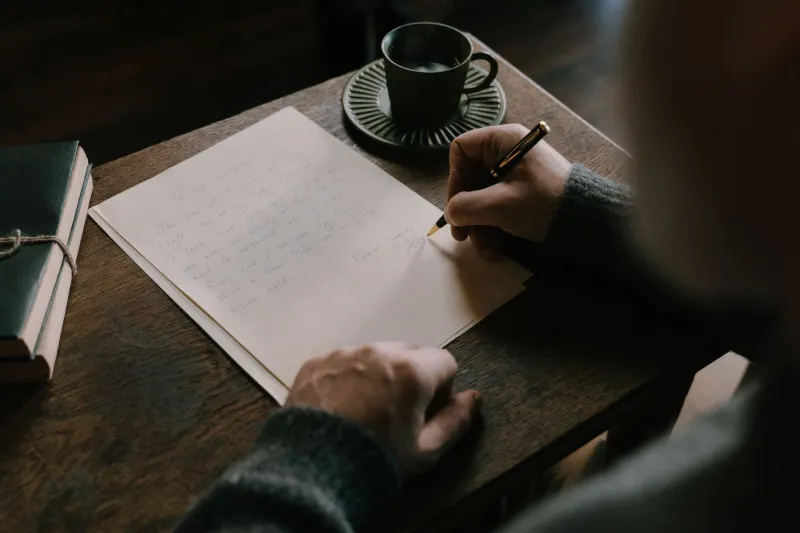
Choosing paper. Picking a pen (and the pen does matter — ask any convert). Sitting at a table with no other agenda. These small, deliberate choices create what psychologists call a "transition ritual" — a signal to the brain that this time is different, that it belongs to something slower and more intentional.
GP and wellbeing advocate Dr Amara Singh has begun recommending letter-writing to patients experiencing burnout. "I tell them to write one letter a week — to anyone, about anything. Not because it fixes the underlying problem, but because the act of sitting quietly, thinking about someone else, and expressing care outwardly is one of the most effective ways I know to interrupt the anxiety spiral. It's free, it's accessible, and it works."
The Post Office's Unexpected Wellness Comeback
Royal Mail, for its part, has noted a meaningful uptick in personal letter volumes in recent years — a reversal of the long decline that had many predicting the end of physical post altogether. Stationery sales at independent shops across the UK have quietly boomed. Fountain pen retailers report a younger customer base than they've seen in decades.
None of this is a coincidence. It reflects a broader cultural appetite for things that are slower, more deliberate, and more human — a pushback against the velocity of modern digital life that is showing up in everything from the revival of vinyl to the resurgence of baking bread from scratch.
The handwritten letter sits squarely in that tradition. It is, at its core, a declaration that someone is worth your unhurried time. That their name deserves to be written, not typed. That the connection between you is real enough to exist on paper, in ink, held in their hands.
In a world of infinite digital noise, that might be the most powerful message you can send.