The Two-Minute Boil That's Quietly Saving British Workers From Burnout
Forget cold plunges. Forget breathwork retreats. Forget the £40-a-month mindfulness subscription you downloaded in January and opened twice. Britain's most effective mental health ritual has been sitting in the corner of every office kitchen since 1979, and it plugs into the wall.
The kettle, it turns out, is doing a lot more than making your PG Tips drinkable.
New research into micro-recovery — the science of brief, deliberate breaks that allow the brain to reset — is shining an unexpectedly warm light on the humble tea break. And what's emerging is remarkable: that two-minute pause between meetings, the one your boss probably considers a productivity drain, might actually be the thing keeping your entire team sane.
Your Brain on 'Boiling'
Here's what happens neurologically when you step away from your screen and wander over to the kettle. First, your visual cortex gets a break — literally. Staring at a monitor keeps certain neural pathways in a state of sustained activation, building up what researchers call "cognitive load." The moment you look away and shift your gaze to something as low-stakes as a kettle filling with steam, that load begins to dissipate.
But it goes further than simple screen relief. The act of making tea is what psychologists call a "structured micro-ritual" — a short sequence of familiar, repetitive actions that requires just enough attention to occupy the conscious mind without taxing it. Boil. Mug. Teabag. Milk. Wait. The brain finds this deeply soothing, in much the same way it responds to other gentle repetitive tasks like knitting or light stretching.
Dr. Sian Lewis, a cognitive psychologist at the University of Bath, has described this kind of ritualistic pause as "active rest" — a state where the brain's default mode network (the part responsible for creativity, emotional processing, and self-reflection) gets to quietly run in the background. "You're not zoning out," she's noted. "You're actually doing something quite sophisticated — you're allowing your brain to consolidate and reorganise."
In short: the kettle is making you smarter, calmer, and more resilient. One boil at a time.
The Social Side of the Brew
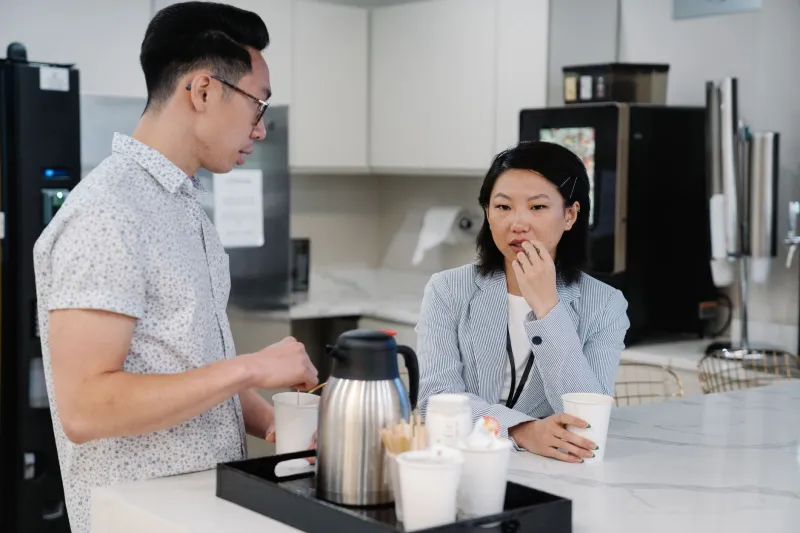
Of course, tea breaks in British workplaces have never really been a solo sport. And that's precisely the point.
The kitchen moment — where someone from accounts ends up chatting to someone from marketing about absolutely nothing important — is, according to social psychologists, one of the most undervalued forms of workplace connection. These low-pressure, unscheduled interactions build what researchers call "ambient belonging": the quiet but powerful sense that you are part of a community, not just a function.
Offices that have stripped away informal break culture in favour of back-to-back Zoom schedules have, perhaps unsurprisingly, reported higher rates of loneliness and disengagement among staff. Meanwhile, a 2023 survey by the British workplace wellbeing consultancy Robertson Cooper found that employees who took regular social breaks — including tea rounds — scored significantly higher on measures of psychological safety and team cohesion.
There's even a term for what happens when you make a brew for the whole office: "prosocial behaviour." And it triggers a small but real release of oxytocin — the bonding hormone — in both the person offering the round and the colleagues accepting it. You're not just making tea. You're chemically reinforcing your social bonds. Over biscuits.
Why 'Doing Nothing' Is Actually Everything
One of the more counterintuitive findings in recent workplace wellbeing research is that the anticipation of a break is almost as beneficial as the break itself. The moment you decide to get up and make a cuppa, your stress hormones begin to ease. Cortisol levels — which spike during periods of sustained concentration or deadline pressure — start to drop before you've even touched the kettle.
This is why mental health professionals are increasingly vocal about the importance of protecting break culture, not just tolerating it. "The British tea break has always been instinctively wise," says workplace therapist Marcus Okafor, who consults with London-based firms on staff wellbeing. "What we're now doing is giving it the scientific language it deserves. This is micro-meditation. It just happens to come with milk and two sugars."
Workplaces that have formalised tea-break culture — designating time away from screens, encouraging communal brewing, even creating kitchen spaces that invite lingering — are seeing the results in their staff retention and absence data. One Bristol-based tech firm reported a 14% drop in stress-related sick days after introducing a structured mid-morning break policy. No yoga. No apps. Just a kettle and the permission to use it.
The Ritual Is the Point
There's something else worth noting about the tea break that sets it apart from other wellness interventions: it requires absolutely no expertise, no equipment beyond what's already in the kitchen, and no particular mindset going in. You don't have to believe in it for it to work.
The ritual carries you. The sequence of familiar actions — filling, waiting, pouring, stirring — creates what psychologists call a "temporal anchor": a predictable, comforting structure in an otherwise unpredictable day. And in workplaces where uncertainty and pressure are constants, those anchors matter enormously.
So next time someone raises an eyebrow at you slipping out mid-afternoon for a brew, you can tell them with complete scientific confidence that you're not skiving. You're engaging in evidence-based stress management, maintaining your cognitive function, reinforcing social cohesion, and regulating your cortisol levels.
Or you could just say you're putting the kettle on.
Same thing, really.