Flour Power: The Surprising Reason Your Weekend Baking Habit Is Better for Your Brain Than You Think
There's a particular kind of Saturday contentment that only bakers know. Flour on your forearms, something warm in the oven, the kitchen smelling like a hug. It feels good — obviously it feels good. But scientists are now telling us it feels good for reasons that go considerably deeper than the prospect of warm scones with clotted cream.
Baking, it turns out, is a genuinely powerful mental health tool. And Britain — with its Great British Bake Off obsession, its sourdough pandemic projects, its proud tradition of traybakes and teatime treats — may have accidentally stumbled into one of the most therapeutic mass hobbies in the world.
Why Your Brain Loves a Recipe
At first glance, following a recipe seems simple. Measure this. Mix that. Wait. But what's happening cognitively is considerably more interesting.
Baking sits at a rare intersection of analytical and creative thinking. You need precision — the wrong ratio of baking powder to flour and your sponge becomes a frisbee — but you also make constant micro-decisions about texture, timing, and taste. This dual engagement is what psychologists call "flow state" territory: the mental sweet spot where you're challenged enough to be fully absorbed, but not so overwhelmed that anxiety creeps in.
Dr. Daisy Fancourt, associate professor at University College London and one of the UK's leading researchers into arts and health, has studied the psychological effects of creative activities extensively. Her work consistently shows that structured creative tasks — baking firmly among them — reduce cortisol levels, lower heart rate, and produce measurable improvements in mood, often within a single session.
"There's something particularly powerful about activities that have a clear beginning, middle, and end," she has noted. "Baking gives you that narrative arc. You start with raw ingredients and finish with something real. That sense of completion is deeply satisfying to the brain."
Kneading as Meditation
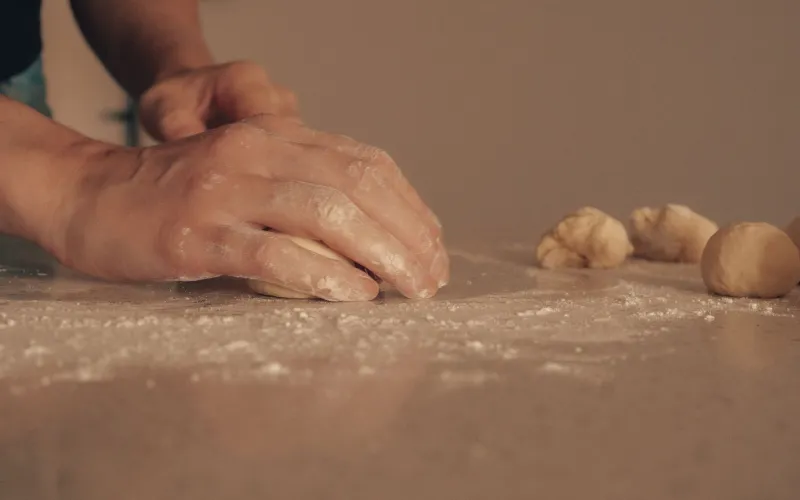
Ask any bread baker what they love most about the process, and a significant number will say: the kneading. There's something almost trance-like about working dough — the rhythmic push, fold, and turn, repeated for ten minutes or more. And they're not imagining the calm it brings.
Repetitive physical motion is one of the most reliable ways to activate the parasympathetic nervous system — the body's rest-and-digest mode. It's why rocking, stroking a pet, or drumming your fingers can all ease anxiety. Kneading bread does the same thing, but with the added bonus of tactile engagement: the sensation of dough changing under your hands provides a grounding, sensory focus that pulls attention firmly into the present moment.
This is mindfulness, in the most unpretentious form imaginable. No app required. No cushion. Just you, some strong white flour, and ten minutes of focused physical rhythm.
London-based psychotherapist Jenna Hartley, who runs baking-based therapeutic workshops in Hackney, has seen the effects first-hand. "I work with clients dealing with anxiety and low mood, and baking consistently produces results that surprise even them," she says. "By the time they've kneaded a loaf, something has shifted. They're calmer, more present, more connected to their bodies. The bread almost doesn't matter at that point — though it's usually excellent."
The GBBO Effect
It would be impossible to talk about Britain's baking renaissance without acknowledging the enormous cultural shadow cast by The Great British Bake Off. Since its debut in 2010, the show has done something quite remarkable: it made baking aspirational without making it intimidating, and it wrapped the whole enterprise in warmth, community, and gentle encouragement.
Amateur baking in the UK surged during the show's peak years, and again dramatically during the 2020 lockdowns, when flour became briefly more coveted than hand sanitiser. But what's particularly interesting is what bakers themselves reported about the experience — not just in terms of skill gained, but in terms of how they felt.
A 2021 survey by the mental health charity Mind found that 89% of people who took up a creative hobby during lockdown — baking among the most popular — reported it had a positive effect on their mental health. For many, it became a genuine anchor: a predictable, absorbing activity in a period of profound uncertainty.
There's also the social dimension. Baking is almost always shared. You make it, and then you give it away — to colleagues, neighbours, family. That act of giving, however small, triggers what psychologists call "helper's high": a genuine neurochemical reward associated with prosocial behaviour. Bringing in a tin of brownies on a Monday morning isn't just lovely. It's, technically speaking, good for your health.
The Smell of Calm
Here's a detail that often gets overlooked in the baking-and-wellbeing conversation: scent.
The olfactory system — our sense of smell — is uniquely wired to the brain's emotional and memory centres. It's the most direct sensory route to the limbic system, the part of the brain that governs mood, anxiety, and emotional memory. Which is why the smell of baking bread or warm vanilla sponge doesn't just seem comforting — it is comforting, in a measurable, neurological sense.
Studies have shown that exposure to warm, sweet baking aromas can reduce perceived stress and induce feelings of nostalgia and safety. It's why estate agents famously suggest baking before viewings. And it's why, at the end of a rubbish week, walking into a kitchen that smells of something in the oven can feel like the closest thing to a reset button that domestic life offers.
Get Baking, Britain
The evidence, in short, is rising nicely. Baking engages your brain in the best possible way, calms your nervous system, connects you to other people, and fills your home with one of the most therapeutically potent aromas known to science.
So if your Saturday plans include a batch of something — a loaf, a tray of flapjacks, a slightly ambitious croissant attempt — know that you're not just indulging a hobby. You're doing something genuinely good for your mental health.
Now preheat your oven. Doctor's orders.